RESEARCH
We work on two foundational areas of mobile and wireless systems:
NextG Wireless Networks
Designing next-generation wireless network architectures (5G, 6G, mmWave) that can serve billions of IoT devices with wire-like connectivity, reliability, and resiliency.
→ NextG Wireless Networks projects
Ubiquitous Sensing
Building ubiquitous sensing techniques that let objects be “truly smart” by understanding and interpreting ambient conditions and micro-activities with high precision — across applications including healthcare, agriculture, AR/VR, and connected buildings.
NextG Wireless Networks
Ubiquitous Sensing
Ubiquitous Sensing
Beyond-Vision Imaging
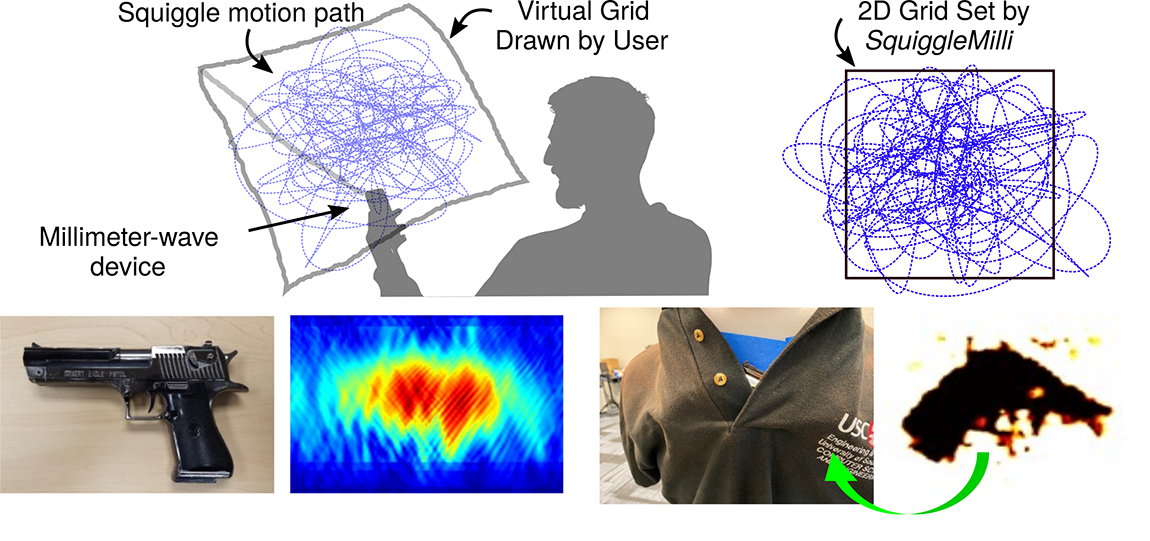
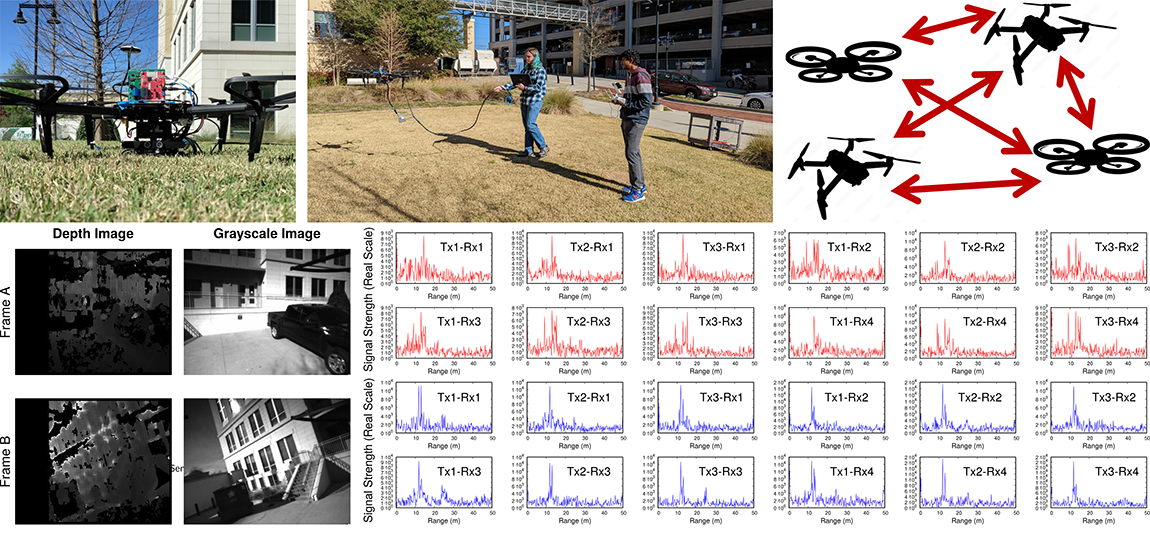
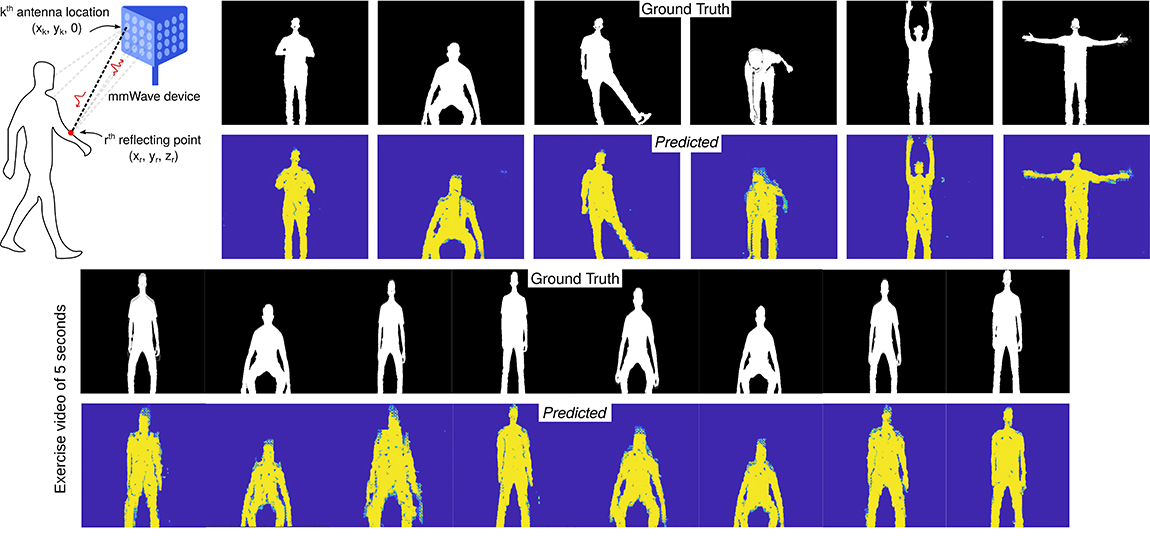 Millimeter-wave (mmWave) systems enable through-obstruction imaging and are widely used for screening in state-of-the-art airports and security portals. They can detect hidden contrabands, such as weapons, explosives, and liquids, by penetrating wireless signals through clothes, bags, and non-metallic obstructions. Besides, mmWave imaging systems could enable applications to track beyond line-of-sight, see through walls, recognize humans through obstructions, and analyze materials without contaminating them. MmWave systems also have advantages over other screening modalities: Privacy preservation and low-light condition usages over optical cameras; very weak ionization effect over X-Ray systems; and shape detection of non-metallic objects over metal detectors. Furthermore, the ubiquity of mmWave technology in 5G-and-beyond devices enables opportunities for bringing imaging and screening functionalities to hand-held settings. However, existing systems require support from infrastructures and are unsuitable for wide deployment. To this end, we are designing and validating practical mmWave imaging systems that are portable and deployable in ubiquitous mmWave devices. We plan to integrate these works on autonomous drones and cars to facilitate safe and secure navigation in the wild under hazardous environmental conditions.
Projects:
NextG Wireless Networks
Ubiquitous Sensing
NextG Wireless Networks
Reliable Deployment
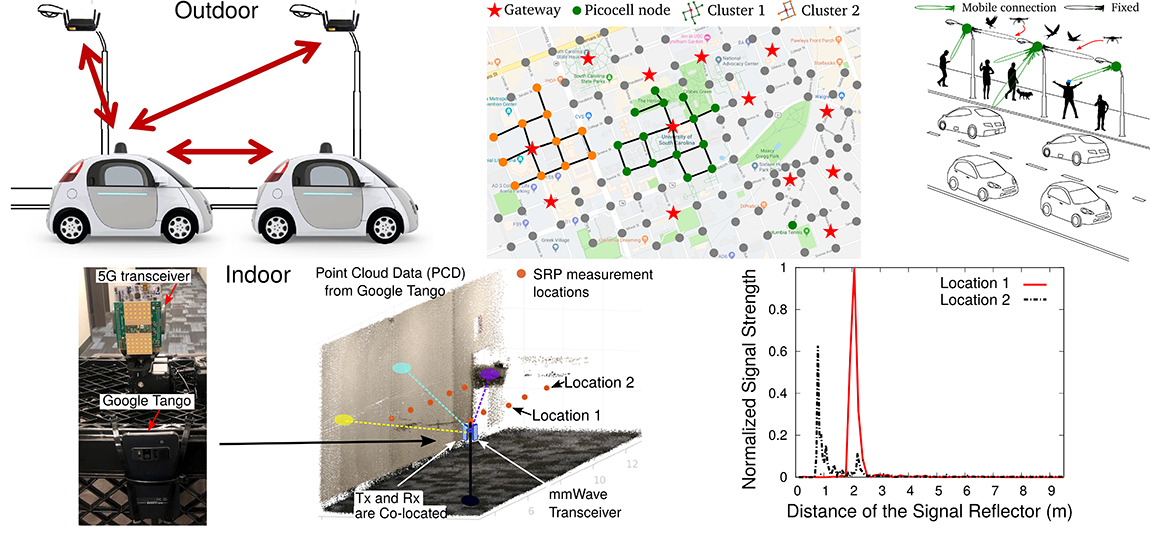 Millimeter-wave (mmWave) networks, the core technology of 5G-and-beyond, offer substantially higher data rates than traditional wireless networks, but the communications are limited to Line-Of-Sight (LOS) and very few reflection paths. So, the network relies on short-range base-stations called “picocells.” Since the paths are prone to obstructions and specular reflections, networks require careful picocell placement. Furthermore, picocells must be densely deployed to compensate for their short-range, and often demand unintuitive placement locations to maximize their effectiveness. Because of the placement density and accuracy requirements, thorough site surveys are often time consuming and expensive. To this end, we have proposed, designed, and validated a low-cost, visual data and deep learning based approaches to predict the mmWave reflections profiles indoors and outdoors, which, in turn, maximize the capacity of the networks by identifying optimal picocell placements. My team is continuing this work to design scalable and real-time systems that can facilitate fast deployment of the NextG network architecture.
Projects: